
📍 Quick Navigation (Page Index)
Looking for Specific Standards & Mill Certificates?
We supply ASTM A106, API 5L, IS 1239, IS 3589 Grade Steel Pipes with NABL Laboratory Test Reports.
📄 Request Mill Test Certificate (MTC)Steel Pipes Specification, Weight Chart & Price List 2026
Complete buying guide for MS, SS, ERW, GI & Seamless Steel Pipes. Get instant weight calculation (KG/Mtr) and factory-direct pricing in India.
Steel Pipes Types, Sizes, Weight Chart & Industrial Uses
| Attribute | Details |
|---|---|
| Product Category | Steel Pipes (MS, SS, GI, ERW, Seamless) |
| Types of Steel Pipes | MS Pipes, Stainless Steel Pipes, Galvanized Pipes (GI), ERW Pipes, Seamless Pipes |
| Size Range | ½ inch to 48 inch (15mm to 1200mm) |
| Wall Thickness | 1mm to 50mm (depending on application) |
| Length | 6m standard / Custom lengths available |
| Weight Calculation | Formula: (OD - Thickness) × Thickness × 0.02466 = Weight (Kg/Meter) |
| Standards | ASTM A106, ASTM A53, IS 1239, IS 3589, API 5L |
| Industrial Uses | Construction, Oil & Gas, Water Supply, Fire Fighting, Infrastructure, Mechanical Industries |
| Pipe Finishes | Black, Galvanized, Polished, Coated |
| Features | High Strength, Corrosion Resistant, Durable, Cost Effective |
| Manufacturer | PS Steel, Delhi, India |
| Delivery | Pan India Delivery & Export Available |
Request a Quote
We have been working around fabrication and construction-related projects for some time, and one thing we’ve consistently noticed is — many people get confused when it comes to steel pipes.
Not just beginners, even experienced professionals sometimes mix up things like types, sizes, and weight calculation.
So we thought of putting together a simple, no-jargon guide that actually helps in real work situations.
🔹 What are Steel Pipes?
In simple words, steel pipes are hollow cylindrical sections made from steel, used to carry fluids, support structures, or for fabrication work.
We can see them everywhere:
- Construction sites
- Industrial plants
- Water supply systems
- Machinery frameworks
They may look simple, but choosing the wrong type or size can affect cost, strength, and safety.
🔹 Common Types of Steel Pipes
This is where most confusion happens. Let’s break it down:
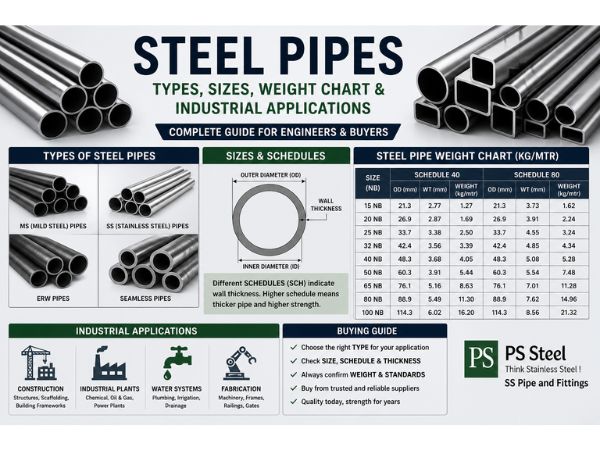
1. MS (Mild Steel) Pipes
These are among the most commonly used pipes in India.
- Affordable
- Strong enough for general use
- Widely used in construction and scaffolding
2. SS (Stainless Steel) Pipes
These are corrosion-resistant.
- Ideal where rust is a concern
- Common in food industry, chemical plants, and water systems
3. ERW Pipes (Electric Resistance Welded)
These are made by welding steel sheets.
- Smooth finish
- Suitable for medium pressure applications
- Cost-effective
4. Seamless Pipes
These pipes have no welding joints.
- High strength
- Used in high-pressure and critical applications
- Higher cost compared to others
👉 Simple understanding:
Normal use → MS or ERW
Critical/high-pressure use → SS or Seamless
🔹 Sizes & Schedules (Easy Explanation)
This part may sound technical, but it’s actually quite simple.
- Size (Diameter): Indicates how wide the pipe is
- Schedule (SCH): Refers to wall thickness
For example, two pipes can have the same diameter but different thickness levels (SCH 40, SCH 80, etc.)
👉 Higher schedule = thicker pipe = more strength and more weight
This directly impacts:
- Pressure capacity
- Cost
- Weight
🔹 Why Weight Matters So Much
From our experience, pipe weight is often underestimated.
It directly affects:
- Material cost
- Transportation planning
- Load calculations
- Structural design
Even small miscalculations can create issues in large-scale projects.
🔹 Weight Chart vs Formula
There are two common methods:
1. Using Formula
Useful for theoretical understanding, but:
- Time-consuming
- Higher chances of error
2. Using Standard Weight Chart
This is what most professionals prefer:
- Quick reference
- Reliable results
- Saves time in real work
We generally rely more on charts instead of calculating each time.
🔹 Industrial Uses of Steel Pipes
Steel pipes are used across multiple industries:
Construction
- Structural supports
- Scaffolding
- Building frameworks
Industrial Plants
- Chemical processing
- Oil & gas pipelines
- Power plants
Water Systems
- Plumbing
- Irrigation
- Drainage
Fabrication Work
- Gates
- Railings
- Machinery frames
🔹 Common Mistakes We See
Based on practical experience, these are common issues:
- Choosing pipes based only on price
- Ignoring thickness (schedule)
- Incorrect weight estimation
- Using MS instead of SS where required
- Not understanding application needs
🔹 Simple Buying Guide (Practical Tips)
If you’re planning to purchase steel pipes, consider this:
👉 Always confirm:
- Type (MS / SS / ERW / Seamless)
- Size (Diameter)
- Thickness (Schedule)
👉 Ask your supplier for:
- Weight details
- Standard specifications
👉 Avoid choosing only the cheapest option
Quality matters in long-term performance
🔹 Final Thoughts
Steel pipes may look simple, but small technical details can make a big difference in real-world projects.
If you are involved in construction, fabrication, or industrial work, having a clear understanding of types, sizes, and weight can help save time, cost, and effort.
We’re curious — how do you usually handle pipe selection?
Do you calculate weight manually or prefer using charts?
Would love to hear your experience 👇
Steel Pipes Types, Sizes, Weight Chart & Industrial Uses
Complete guide for Industrial Steel Pipes including MS, ERW, Seamless & GI Pipes used in fabrication, construction, and heavy industries.
| OD (mm) | Size (Inch) | Thickness (mm) | Weight (Kg/Mtr) | Usage |
|---|---|---|---|---|
| 21.3 | ½" | 2.0 | 0.98 | Light Fabrication |
| 26.9 | ¾" | 2.0 | 1.25 | Structure Support |
| 33.7 | 1" | 2.5 | 1.90 | Fabrication / Machinery |
| 48.3 | 1½" | 3.0 | 2.75 | Industrial Frames |
| 60.3 | 2" | 3.2 | 3.90 | Heavy Fabrication |
| 76.1 | 2½" | 3.2 | 5.00 | Structural Projects |
| 101.6 | 4" | 4.0 | 9.50 | Industrial Pipeline |
Types of Steel Pipes
- MS Pipes (Mild Steel)
- ERW Pipes
- Seamless Pipes
- GI Pipes (Galvanized)
- Stainless Steel Pipes
Industrial Applications
- Construction & Infrastructure
- Oil & Gas Pipelines
- Water Supply Systems
- Mechanical & Fabrication Work
- Heavy Equipment Structures
Get Best Price for Steel Pipes
PS Steel – Other Products & Weight Charts
Explore the complete range of PS Steel Products with detailed specifications, weight charts, and catalogues. Click on each product link below for more details.
MS Plate Weight Chart in KG
Check the complete Mild Steel Plate weight chart in kilograms for accurate project calculations.
SS 304 Channel Weight Chart
Find the Stainless Steel 304 Channel weight chart with standard sizes and dimensions.
Chequered Plate Stainless Steel
Browse high-quality SS Chequered Plates with weight chart and available sizes.
Mild Steel Channel
Explore Mild Steel Channel specifications with complete weight and size details.
SS Rectangular Tube Weight Chart
Check the Stainless Steel Rectangular Tube weight chart with size variations for industrial use.
Stainless Steel Pipe Fittings Catalogue
Download and view the complete Stainless Steel Pipe Fittings catalogue with specifications.
Industrial MS Pipe Weight Chart
Get the full Industrial Mild Steel Pipe weight chart for construction and engineering projects.
Stainless Steel Flanges Weight Chart
Check SS Flanges weight chart including available classes and pressure ratings.
Stainless Steel Pipe Gauge Chart
Find accurate SS Pipe Gauge chart for thickness and weight measurements.
Steel Square Pipe & Tube Weight Chart
Browse the complete Steel Square Pipe & Tube weight chart with standard dimensions.
Welded SS Pipe Weight Chart (PDF)
Download the Welded Stainless Steel Pipe weight chart in PDF format with KG values.
Mild Steel & Stainless Steel Pipes
Explore a wide range of Mild Steel and Stainless Steel Pipes for industrial applications.
Stainless Steel Channel Weight Chart India
View the Stainless Steel Channel weight chart with Indian market standard sizes.
Connect with PS Steel
Trusted Steel Supplier for Industrial & Fabrication Projects in India
Business Profiles
Company Details
Company Name: PS Steel
GST Number: 07ALKPR4721N1ZK
Location: Delhi, India
Chat on WhatsApp📌 Frequently Asked Questions (Steel Pipe Buyer's Guide)
How to calculate steel pipe weight in KG/Meter?
You can use the standard formula: (OD - Thickness) × Thickness × 0.02466 = Weight (Kg/Meter) or directly refer to our verified weight chart above for instant specifications.
What is the difference between ERW and Seamless Steel Pipes?
ERW pipes feature a welded seam and are cost-effective for medium-pressure plumbing and structural use. Seamless pipes have no joints, offering maximum tensile strength for high-pressure oil, gas, and chemical pipelines.
Do you supply custom length and cut-to-size MS & SS pipes?
Yes, PS Steel provides factory-direct custom lengths, custom wall thickness (Schedules 10 to 160), and specialized anti-rust coating as per client requirements across India.
Need Custom Sizes, Weight Estimates, or Wholesale Bulk Prices?
Talk directly with our Steel Pipe Technical Team for immediate pricing and mill test certificates.
📲 Get Instant Factory Quote on WhatsApp